
Prickly pear Arc Raiders: where to find them and what they actually do
A prickly pear in Arc Raiders is a small foraged fruit that grows on cacti scattered across two maps. It is one of the rarer food items in the game because plant spawns are scarce to begin with, and most of the maps you visit contain no cactus at all. Players who want a steady supply of prickly pear Arc Raiders supplies will need to plan repeated runs to a handful of known clusters rather than expect a single raid to deliver the full stack.
The item matters for two distinct reasons. During a raid you can eat a prickly pear to restore stamina when you are running low, which is a useful emergency option. The more important use, however, is long-term: you need six prickly pears to upgrade Scrappy the Rooster, the companion who gathers extra crafting materials between your raids. Because Scrappy’s efficiency depends on upgrade tier, the prickly pear is effectively a progression gate disguised as a foraging item.
The rest of this guide focuses on the practical farming side of prickly pear Arc Raiders collection: how the spawn system works, where the cactus clusters are concentrated, how to plan a route, and which decisions actually change your odds of getting all six.
How prickly pear spawning works in Arc Raiders
Prickly pears do not have a rarity tier in the same way weapons or armor do. The reason they feel rare is structural: food items as a category spawn far less often than combat gear, and prickly pears specifically only appear on cacti. Because cacti only populate two maps, every prickly pear you ever pick up comes from one of those two locations, regardless of how many raids you run elsewhere.
The spawn behavior also has a few quirks that complicate farming:
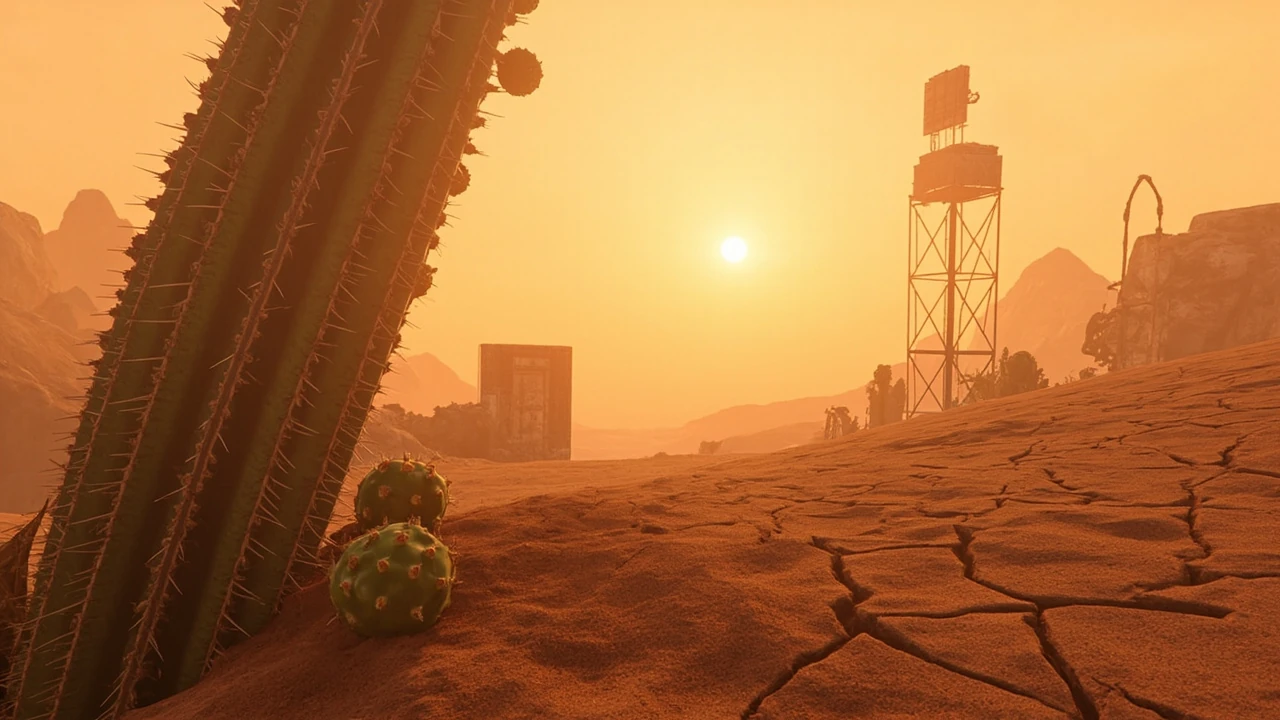
- Prickly pears appear on the ground around the base of a cactus, not on the plant itself. You need to look down, not up.
- Cacti have distinctive spiky leaves that separate them from ordinary desert foliage, but on low graphics settings they can look like generic plants at a distance. Plan to approach them directly rather than trying to spot them from across a field.
- Individual spawns are low and partly random, so even the best cluster will not give you a full set of six in one raid. The farming loop is built around repetition, not single-run efficiency.
Because spawns are inconsistent, a common mistake is to assume that a bad run means a location is wrong. In practice, two players hitting the same patch on the same day can see very different yields. Treat each cactus as a small chance, not a guarantee, and design your route so any prickly pear you do find makes it safely back to your stash.
Which maps have prickly pear cactus spawns
Prickly pears only spawn on two maps in the current build: Dam Battleground and Buried City. Every other playable map supports general plant foraging, but it will not give you prickly pears. If you want to make progress on the Scrappy upgrade, restricting your farming runs to these two maps is the single most important decision you can make.
| Map | Has prickly pear cacti | Typical use for farming |
|---|---|---|
| Dam Battleground | Yes | Efficient short runs near extraction zones |
| Buried City | Yes | Larger southern patch with dense cactus concentration |
| All other maps | No | Not viable for prickly pear farming |
Player reports vary on which of the two maps is more reliable. Some guides describe Dam Battleground as the best spot, while others claim Buried City produces more consistent results. The honest answer is that both maps contain meaningful cactus concentrations, and the better choice depends on your playstyle, your typical survival rate, and how far you are willing to run between clusters. Treat the two maps as complementary rather than competing options.
Dam Battleground prickly pear locations
Dam Battleground is a strong starting map for prickly pear Arc Raiders farming because the cactus clusters sit close to extraction points, which shortens the distance you need to cover after picking. That matters a lot when a raid is going badly and you need to cut your losses.
The two main cluster areas are:
- Northern cactus group, on the left side of the Power Generation Complex. The spot is near where the two main roads meet at the top of the map, and an extraction zone is right beside it, so you can grab what you find and leave quickly.
- Central cactus group, beside the Research and Administration area, just below it once you exit the red boundary line. This cluster is also next to an extraction zone, which makes it a fast turn-around for short farming runs.
Both Dam Battleground clusters are positioned so that a quick loop into the patch, a sweep of the ground, and an extraction is enough to make a raid worthwhile even if you find nothing else of value. If you are new to the map or still learning its rotation, starting with these two clusters is the lowest-risk way to make slow but steady progress toward your six pears.
Buried City prickly pear locations
Buried City is the second map with prickly pear cacti, and the southern edge of the map is the single densest cactus patch in the game. If Dam Battleground is about efficiency, Buried City is about yield per run, with a longer travel distance to compensate.
Key clusters on Buried City include:
- The southern cactus patch, located past the southernmost yellow boundary of Old Town. This is widely described as the best spawn location in the game and behaves like a proper cactus grove rather than a few scattered plants.
- An eastern cactus group near the eastern spawn point, useful for early-game raids where you want to grab a quick prickly pear without committing to a long route.
- A northeastern cluster near some buildings, which can be combined with other loot in the area if you are running a higher-risk route.
The southern patch is the highest-value target for dedicated farming, but it is also the furthest from the typical extraction paths. Plan a route that brings you back toward the map’s main road network rather than wandering deeper into the desert after each pick.
Planning a prickly pear farming run
Because prickly pears are low-spawn and high-value, the structure of a farming run matters as much as the location. A good run sequence reduces wasted time and gives you a chance to extract even if the patch is empty.
Use this rough sequence when you set up a run:
- Choose your map based on your confidence: Dam Battleground for safer, extraction-adjacent routes; Buried City for higher yield at longer travel distance.
- Identify the cactus cluster you want to hit first based on your spawn position. Always start with the cluster closest to where you drop in.
- Sweep the ground carefully around each cactus. Pristine prickly pears blend into the sand, especially in golden-hour lighting, and they only confirm their presence on close inspection.
- Stash any prickly pear you find in your safety pocket immediately. Do not leave it in your main inventory, where death costs you the entire run.
- Move to the second cluster, then decide whether to continue to a third or extract based on remaining time and threat level.
- Extract at the nearest viable extraction zone rather than pushing for one more cluster if the run has already turned against you.
The safety pocket is the single most important habit for prickly pear Arc Raiders farming. Losing a stack because you held it in your main inventory and died is by far the most common way players reset their progress, and the spawn rate is too low to absorb that kind of loss casually.
How prickly pears feed the Scrappy the Rooster upgrade
Scrappy the Rooster is your passive companion who gathers crafting materials between raids. His value scales with his upgrade tier, and one of his upgrade requirements is a stack of six prickly pears. Without the upgrade, Scrappy returns a baseline amount of material; with it, the per-raid return increases, which compounds over time across every map you play.
The reason prickly pear Arc Raiders farming is treated as a side progression goal rather than a casual activity is that the requirement is a hard gate. You cannot substitute other food items for the prickly pears, and you cannot buy the upgrade directly. The choice is between farming the six pears yourself or waiting for random drops across many raids.
For most players, the practical implication is simple: once you have three or four prickly pears banked, treat every cactus you pass as worth at least a brief detour. A single pear found during an unrelated raid is far more efficient than starting a fresh farming run from zero.
Decisions that change your farming efficiency
Several choices in your loadout and run planning have an outsized effect on how fast you finish the prickly pear Arc Raiders upgrade. None of them is mandatory, but each one removes friction from the loop.
| Decision | Effect on farming | When to choose it |
|---|---|---|
| Free loadout run | No risk to gear if you die, but weaker combat ability if another squad contests a cluster. | Best when you are not confident about extracting with a full inventory. |
| Equipped loadout run | Better survival tools, but you lose the gear on death. Higher per-run yield if you survive. | Best when you consistently extract and want to push extra loot on each pass. |
| Dam Battleground first | Shorter routes, extraction-adjacent clusters, lower per-run yield ceiling. | Best for early progress and players still learning the map. |
| Buried City first | Longer travel, higher per-run yield ceiling at the southern patch. | Best for confident extractors who want to clear the upgrade in fewer runs. |
| Stash on every pick | Guarantees that no single death resets your progress. | Always. Treat it as a non-negotiable habit. |
The single most underrated decision is the free loadout. If you die often, the free loadout keeps your kit intact for other activities, and you still make progress on the prickly pear Arc Raiders upgrade. The math only flips when your survival rate is consistently high enough that the extra gear consistently translates into more pears per run.
Common mistakes when farming prickly pear Arc Raiders
Most of the friction in prickly pear Arc Raiders farming comes from repeating the same avoidable mistakes. A short list is worth more here than a long explanation, because the underlying mechanics are simple.
- Expecting six pears in one run. Spawn rates are too low for that. Plan for a multi-run campaign, not a single raid.
- Trusting long-range cactus identification on low graphics. The cacti lose their distinctive leaves at distance. Move in close before assuming a plant is worth stopping for.
- Carrying prickly pears in the main inventory. A single death wipes the run. Move them to the safety pocket as soon as you pick them up.
- Ignoring isolated cacti outside the named clusters. They are lower yield, but they exist, and a stray pear is a real reduction in the number of dedicated runs you need.
- Searching the wrong maps. Wasting time on maps without cacti is the fastest way to delay the Scrappy upgrade.
Each of these mistakes is easy to fix in isolation, but they compound. A player who fixes the safety pocket habit and stops searching non-cactus maps will see a noticeable jump in effective yield per hour, even without changing anything else about their playstyle.
How long the prickly pear Arc Raiders grind realistically takes
There is no guaranteed timer, and the actual time depends on how often you run cactus maps, how lucky your spawns are, and how many pears you happen to find incidentally. A player who focuses on Buried City with confident extractions may finish in a handful of focused runs. A player who only visits Dam Battleground during unrelated raids will take longer simply because they are not optimizing for yield.
A reasonable way to frame the grind is in terms of the upgrade’s value, not the time it takes. The Scrappy upgrade improves material returns on every future raid, so even a slow prickly pear Arc Raiders grind pays for itself over the course of several subsequent play sessions. Treat it as a small investment in long-term material income rather than a one-time chore.
Other uses for prickly pears during a raid
The stamina restoration use of a prickly pear is easy to forget because it is overshadowed by the Scrappy requirement, but it has real value during a raid. If you are low on stamina in the middle of a contested zone, eating a prickly pear gives you a short window to reposition, reach cover, or make a break for an extraction point.
That creates an internal trade-off. The same prickly pear that you could stash for the Scrappy upgrade can also save a run that is going badly. Most players will want to bank at least four pears first and then start using the spare ones for stamina, because the upgrade gate is the longer constraint. Once the upgrade is complete, every additional pear becomes a free stamina refill.
How prickly pears fit into a broader Arc Raiders progression plan
Prickly pears are one of several material gates that unlock companion or equipment upgrades. They are not the only rare item worth farming, and they should not crowd out your broader progression goals. A balanced plan treats them as a parallel track rather than a solo project.
Useful rules of thumb for an overall plan:
- Keep the safety pocket discipline for any rare plant you pick up, not just prickly pears. The same habit applies to other crafting materials.
- Run cactus clusters opportunistically. If you are already passing through Dam Battleground or Buried City for another objective, sweep the nearest cluster on the way.
- Save dedicated prickly pear runs for sessions where you are not chasing other progression targets. Splitting attention between two goals in one raid usually reduces the efficiency of both.
- Once the Scrappy upgrade is complete, revisit the cactus clusters only when you want stamina refills or incidental food. The hard farming loop ends at six.
Sticking to these habits turns the prickly pear Arc Raiders grind from a frustrating side task into a small, predictable part of your weekly play loop.
Frequently asked questions
Where do prickly pears spawn in Arc Raiders?
Prickly pears only spawn on the ground near cacti, and cacti only appear on two maps: Dam Battleground and Buried City. Every other map in the game lacks cactus spawns entirely, so prickly pear farming is restricted to those two locations.
What are prickly pears actually used for?
You can eat a prickly pear during a raid to restore stamina, but the main use is progression. You need six prickly pears to upgrade Scrappy the Rooster, which increases how many crafting materials he gathers between your raids.
Is Dam Battleground or Buried City better for prickly pear farming?
Both maps have meaningful cactus concentrations, and player reports on which is better are mixed. Dam Battleground offers extraction-adjacent clusters that suit shorter, safer runs, while Buried City has a denser southern patch that rewards confident extractors willing to travel further.
How long does it take to find all six prickly pears?
There is no fixed timer because spawns are low and partly random. A focused farmer running Buried City can finish in a handful of dedicated runs, while a player who only picks up incidental pears during unrelated raids will take much longer. Plan for a multi-session grind rather than a single raid.
Can I buy prickly pears from a vendor instead of farming?
No. Prickly pears are not a vendor item in the current build. The only reliable way to obtain them is to find them on the ground near cacti on Dam Battleground or Buried City.
Should I keep prickly pears in my safety pocket?
Yes. Stashing prickly pears in the safety pocket immediately after picking them up is the single most important habit for this grind, because losing the run wipes your main inventory and resets progress. The safety pocket guarantee is the only reason the multi-run grind is feasible.
What does the Scrappy the Rooster upgrade actually do?
Scrappy gathers crafting materials between your raids, and the upgrade increases how many materials he returns on each passive cycle. Because this compounds across every future raid, the six-pear requirement is a long-term investment in material income rather than a one-time benefit.
Do I need to identify cacti from far away to farm efficiently?
No, and trying to do so on low graphics settings is a common mistake. Cacti can look like generic desert plants at distance on low settings, so the most reliable approach is to navigate to the known cluster coordinates and check the ground up close rather than scouting from afar.
Are prickly pear spawns the same on every server or session?
Spawns are partly procedural, so two players hitting the same cactus cluster in the same window can see different yields. The cluster locations are consistent, but the per-plant prickly pear presence is randomized within those clusters.
Should I use a free loadout for prickly pear farming?
A free loadout is the safer choice if you are not confident about extracting with loot, because dying costs you nothing beyond the prickly pears you may have stashed. An equipped loadout is worth it only when your survival rate is high enough that the extra combat ability consistently translates into more pears per run.
Leave a Reply